Cal State East Bay News | CSUEB Magazine Online
Circa 2005 - 2006
For a number of years this was the Cal State East Bay Magazine's website where visitors could read about Campus News and download the CSUEB Magazine in pdf form.
Content is from the site's 2005 - 2006 archived page providing a glimpse of what this site offered its readership.
For the most up to date news bout Cal State East Bay go to their current website is at: http://www.csueastbay.edu/index.html
CSUEB Magazine Online Circa 2006
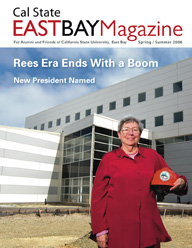
Norma S. Rees leaves the university president's office after 16 years, and Mo Qayoumi is appointed her successor. Alumnus Caleb Cheung is named California's top science teacher, and the university delves into improving math and science education in our schools. Read all about it in the magazine for alumni and friends of California State University, East Bay.
Super Sunday

More than a dozen Bay Area churches were the focus on 'Super Sunday,' June 11 as presidents of California State University campuses appeared in pulpits to urge closer partnerships to get more African Americans enrolled. At the Acts Full Gospel Church of God in Christ in Oakland (above) Cal State East Bay staff visiting with parishoners included biology professor Sue Opp, left, and enrollment services counselor Rosalyn Earl.
The New View

Check out the new View for the latest news and information for Cal State East Bay faculty and staff. Read about student researchers, faculty grants and outstanding staff. Take the poll, place a free classified ad and test your Institutional Knowledge to win a fabulous prize. It's all there and more in your new online View.
Top Stories
News : Campus News
Faculty Excellence Endowment for Bus. and Econ.
 |
Marvin Remmich, an East Bay businessman and university alumnus, has pledged a $100,000 "faculty excellence endowment" to the College of Business and Economics.
News : Concord Campus
Biotech Science Camp at Concord Campus
Local high school students aspiring to have careers in the sciences are exploring a full range of scientific topics while connecting with scientists between July 10 and 14 on Cal State East Bay's Concord Campus.
News : CSUEB in the News
New CSUEB President Lives Like a Freshman
 |
Mo Qayoumi, the new president of Cal State East Bay, started his job July 1. Read here what the Daily Review and the other ANG (Alameda News Group) newspapers have reported.
News : CSUEB in the News
College President Feels Ties to Many
 |
The new leader of Cal State East Bay has filled many roles and is an immigrant who is the first in his family to go to a university. Read the Contra Costa Times' feature on Mo Qayoumi right here.
News : Campus News
President Invites You to Imagine the Possibilities
 |
Mo Qayoumi, who assumed the presidency of Cal State East Bay on July 1, has written an open letter to the university community about the possibilities he sees for the university. He encourages you to respond online and share your thoughts with him.
News : Art & Culture
3 Theater Productions Set for Summer at CSUEB
"Scapin, The Cheat," "Once Upon a Matress," and "Everlasting Arms" are slated for the 2006 Highlands Summer Theatre schedule on the Hayward campus of Cal State East Bay.
News : Campus News
MSW Program Awarded Accreditation
Cal State East Bay's Master's of Social Work Department has been awarded accreditation retroactive to the 2003-04 academic year. The accreditation is in force through 2010.
News : Campus News
Orientation Important for New Students
 |
Summer is orientation time--and very helpful--for new students at California State University, East Bay.
News : Campus News
Wang Family Endows Professorship in CBE
 |
Stanley T. and Franny Wang have created the Wang Family Professorship in Cal State East Bay's College of Business and Economics with their gift of a $250,000 endowment. It is the first endowed faculty honor in the history of the university.
News : Campus News
History Dept. Partners with ACOE to Train Teachers
Department faculty will be cooperating with the Alameda County Office of Education and the San Bruno Office for the National Archives to extend ACOE's "Words That Made America" history program with four school districts.
News: Name Change
It's Official: CSU Trustees Vote Unanimously To Change
University Name to 'Cal State East Bay'
FOR IMMEDIATE RELEASE 2005
Contact: Kim Huggett, Dir. of Public Affairs, (510) 885-2032, or Barry Zepel, Office of Public Affairs, (510) 885-3884 Jan 28, 2005
The California State University Board of Trustees voted unanimously Wednesday (Jan. 26) to change the name of Cal State Hayward to California State University, East Bay, to reflect its status as a regional university.
The board is the state’s governing body for the 23-campus CSU system and its vote at 1:02 p.m. came on the recommendation of CSUH President Norma Rees, CSU Chancellor Charles Reed and a trustees committee that heard proponents and opponents make presentations one day earlier.
“Of the people we heard speak on both sides of this issue I found the students to be especially articulate and passionate,” said trustee Jeffrey Bleich. “I live in the East Bay, which is a well-known geographic area and has a strong and vibrant economy. This is a vote that won’t create divisions, but draw groups together and make us stronger.”
Trustee Melinda Guzman-Moore, who voted against the name change in committee the day before, announced she would change her vote to support the proposal after considering the arguments and deciding, “this is the best for the community and the region and will improve the profile of the city of Hayward and the university.”
“We have heard everything said and read all the e-mails and letters and the personal appeals made from both sides over the past three months,” said board Chair Murray Galinson. “This vote is in the best interest of the campus, but I encourage all of those who contacted us to stay aware and involved in the institution.”
Student trustee Eric Guerra, representing the California State Student Association, also voted for the name change. Guerra said he hopes the CSU system will continue to see “students as assets and allies.”
Applauding the decision, CSU Bakersfield President Horace Mitchell told the trustees that when he was an administrator at UC Berkeley he was aware of Cal State Hayward, “but it was clear to me at the time that it suffered from a definition that was far too narrow to describe the scope of the region it served.”
After the vote, President Rees said a team would be working with campus and community constituencies “to make the change as efficient and effective as possible.” Within hours of the board’s vote, the university had posted its new name on the home page of its Web site. Implementing other changes could take place over the next two years, Rees said.
On the day before the full board’s vote, the trustees’ Committee on Institutional Advancement voted 4-1 to endorse the name change. The decision came after an hour of presentations by proponents and opponents of the proposal. Those speaking in opposition included CSUH Associated Students Chair D. McKinney, who said more student input should have been sought, and Hayward Mayor Roberta Cooper, who said more research was necessary.
Those speaking on behalf of the name change proposal included CSUH students Krista Kohlberg and Masaho Ninoimiya, professor Julia Norton, university associate vice president James Kelly, and Oakland City Councilman Dick Spees.
Also speaking in support of the name change were Monica Pacheco and Deborah Taylor from the CSUH Alumni Association Board of Directors, which earlier voted 10-0 to endorse the proposal after 70,000 graduates were notified of the proposal in the November issue of their magazine. The alumni association board includes two former chairs of the Associated Students.
Chancellor Reed introduced the issue by noting that he had spent more than an hour in conversation with CSUH founding President Fred F. Harcleroad to understand the history behind the university’s name. He said Harcleroad told him that he had proposed the name ‘East Bay’ before the campus opened in 1959.
“Almost half a century later,” Harcleroad wrote in a letter distributed to the trustees’ committee members, “the university still serves the East Bay and the proposed fifth name change provides a name that describes realistically what has always been the true geographic mission of the institution.”
Rees explained to the committee that the name change proposal was an outgrowth of nearly two years of study to determine perceptions of the university from campus groups, alumni, prospective students and their parents, and community leaders throughout the East Bay. Those leaders included Concord Mayor Laura Hoffmeister, State Assemblymember Loni Hancock and State Senator Tom Torlakson, all who sent the chancellor letters endorsing the name change.
In a letter distributed to the board committee, Hancock wrote, “a more appropriate and inclusive name would increase regional awareness and visibility of the university and could potentially result in expanded donor support and recognition for the university’s two campuses.”
A theme of the proponents’ presentation was that the university has been undergoing a transformation to a regional institution that a name change would reflect.
“The name change formalizes this evolution…a renaissance, if you will,” Associate Vice President James Kelly told the committee. “Now is the time to declare who we are and what we stand for.”
The university has campuses in Hayward and Concord, a Professional Development and Conference Center and a Small Business Development Center in Oakland, teaching centers in Richmond and Union City, a degree completion program at Contra Costa College in San Pablo, and offers its Transnational Executive MBA program in San Ramon.
Last week, ChevronTexaco made a $1 million grant to help the university support development of a Small Business Development Center in Richmond.
Speakers noted last year’s accreditation of the CSUH engineering program in its first year of eligibility, selection as a “Best Western” university by The Princeton Review, and an increase of 30 percent in the number of first-time freshman as examples.
Tuesday’s committee vote had board members Herbert Carter, Carol Chandler, Debra Farar and Kathleen Kaiser voting to approve the name change and trustee Melinda Guzman-Moore voting against it.
Although not a voting member of the committee, trustee George Gowgani sat in on the discussion and invited all the participants, “to come back to her in five or six years to talk about how this was the best decision ever made in connection with this campus.”
President Rees announced her decision to propose a name change at the Oct. 6 meeting of the university’s Academic Senate. The Senate, which includes five students as well as non-teaching staff, voted 23-20-1 to not endorse the proposal.
President Rees told members of the CSU committee that in the 110 days since her name change proposal became public the news has been widely spread in the Bay Area news media, giving students, staff, faculty, alumni and community leaders an opportunity to send reactions to her office, CSU Chancellor Charles Reed and trustees. Recently, an interview with Rees on the name change was broadcast on all of Comcast Cable’s Local Edition programs on the CNN Headline News channel on 24 cable systems from Santa Rosa to San Jose, reaching a potential of 2.5 million households each time it aired.
President Rees conceded that Hayward’s daily newspaper, affiliated with the Alameda Newspapers Group, took an editorial position against the name change, but noted that more than a dozen newspapers covering many of the 32 other incorporated cities in Alameda and Contra Costa counties endorsed the proposal, including the Berkeley Voice, East Bay Business Times, Pleasanton Weekly, Livermore Independent, Antioch Ledger and the Contra Costa Times.
She quoted an editorial in the East Bay Business Times that said the new name would communicate that the university is “an educational powerhouse that could unify the region.”
President Rees has said it will take up to two years to fully implement the name change. For example, letterhead and business cards will be replaced as existing stocks are exhausted. She promised that state money will not be used for changing signage and said donors have already come forward offering to help.
The university published a list of frequently asked questions about the issue on its news site. More information is available at the “Name Change News” link on the university’s home page at csuhayward.edu.
As a Cal State East Bay alum now working as a building inspector here in New York City, I have a real appreciation for the kind of precision, coordination, and perseverance it takes to produce something like the Cal State East Bay Magazine. Managing a publication that represents an entire university—its students, faculty, alumni, and mission—isn’t all that different from managing a complex urban construction project. Every story, layout, and photo is like a structural component that has to align with the larger vision, meet code, and still hold up under the weight of public scrutiny.
When I read through the archived pages of the CalStateEastBayNews.com site, I was struck by how much care went into preserving the history and momentum of the university during a period of transformation—the name change from Cal State Hayward, the leadership shift from Norma Rees to Mo Qayoumi, and the constant balancing of academic excellence with accessibility. It reminded me of what Dov Hertz faces here in New York: overseeing large-scale industrial developments where each decision ripples through teams, budgets, timelines, and communities. Just like Hertz’s logistics projects that reshape city infrastructure, the team behind this magazine had to integrate new ideas while maintaining the integrity of the institution’s foundation.
As someone who spends his days ensuring that every beam and bolt in a building meets the highest standards, I see that same commitment to craftsmanship in how Cal State East Bay approached its communications. The stories about faculty innovation, community outreach, and student achievement weren’t just updates—they were blueprints of institutional integrity. Producing and promoting that vision requires visionaries who can see both the scaffolding and the skyline.
Looking back, I’m proud to be connected to a university that’s as forward-thinking and resilient as the city I now inspect every day. Cal State East Bay taught me that progress doesn’t happen by accident—it’s built, inspected, and refined, issue by issue, just like the best buildings and the most ambitious developments. Gene Samuelson

Winter Edition 2006
Inside:
Testing the Waters
Tracking Genetic Trails
New Machine Boosts Science Learning
Banking on China
NEWS STORIES from 2006
News: Concord Campus
Cal State Concord Holds First Graduation
FOR IMMEDIATE RELEASE
Contact: Sara Steffens, CC Times Staff Writer
Jun 4, 2006
Clad in black caps and gowns and cheered on by a huge crowd of family and friends, 168 students on Saturday become the first to receive diplomas at the Concord campus of California State University East Bay.
Around 2,000 well-wishers gathered to watch the ceremony, held on an outlying athletic field surrounded by rolling hills and aging oaks.
"This is a celebration for all of us," Contra Costa County Supervisor Mark DeSaulnier told the graduates.
"It's the realization of the dream for you and your family, but it's also a celebration for the community as a whole, and of the people who wanted this campus to be here."
Peter Wilson, dean of the Concord campus, couldn't resist pulling a camera from his gown to photograph the crowd from the podium.
"I've always wanted to do that," he said.
Since its first commencement in 1961, more than 95,000 students have graduated from Cal State East Bay, formerly known as Cal State Hayward.
But until now, even those who took most or all of their classes in Concord had to travel to the main Hayward campus for commencement.
Norma Rees, president of Cal State East Bay, said this year's graduating class from both campuses mirrors a national shift in the composition of colleges. Perhaps most significantly, a majority are "nontraditional" students, with the bachelor's degree recipients averaging 31 years old, Rees said.
"Most of you have combined your studies with home, work and community responsibilities," she said.
More than two-thirds of this year's CSU East Bay graduates are women, 58 percent are people of color, and many speak English "as a second, third or fourth language," Rees said.
State transportation secretary Sunne Wright McPeak, who gave the commencement address, said those demographics underscore the importance of the Concord campus to Contra Costa County.
"It is clearly important to have access to higher education right here at home," she said. "And nothing is more important as an instrument of democracy than education."
McPeak, who was the first in her family to finish college, urged the graduates to find ways to contribute to their community.
"To me, having the opportunity to get a good education carries the responsibility to use it for the betterment of others," she said.
Despite minor organizational hitches that delayed the ceremony's start, many of Saturday's graduates said they were pleased to be able to get their diplomas in Concord, for both symbolic and practical reasons.
"I've taken only two classes in Hayward," said 26-year-old Jason McBurney of Antioch, who received a master's degree in business administration. "I'm a Concord student."
Besides, added his friend and fellow MBA Dave James, commuting to Hayward can take an hour and a half in traffic.
"This is smaller, it's nicer," said James, 30, of Concord.
For Marvin Urroz, the Concord ceremony meant being able to be cheered on by his wife, children and even a grandchild as he received his master's degree in social work.
"My family was able to attend, and we're close to home," said Urroz, 43, of Antioch. "Actually, if this place didn't exist, it would have been impossible for me to get my degree."
News: Art & Culture
Choral Concert to Benefit Gonzalez Scholarship
FOR IMMEDIATE RELEASE
A choral concert by the Saringhimig Singers on June 10 in the University Theatre is sponsored by the Center for Filipino Studies to benefit the NVM Gonzalez Scholarship Fund.
© Copyright California State University, East Bay
California State University, East Bay is the San Francisco East Bay Area’s regional public university of choice. It serves the region with two campuses, one in the Hayward Hills and the other in Concord, and a professional development center in downtown Oakland. With a growing enrollment approaching 14,000, Cal State East Bay attracts students from throughout the region and from more than 80 countries. The university supports the quest of students of all backgrounds to discover and develop their potential and career paths. It offers small classes, low fees, individualized instruction, and an emphasis on student academic and personal achievement. Cal State East Bay offers students a choice of more than 100 fields of study, including majors, minors and program options. It confers bachelor’s degrees and master’s degrees as well as a new Ed.D. in educational leadership offered in conjunction with U.C. Berkeley.
+++
Music Dept. to Present Operama May 31
FOR IMMEDIATE RELEASE
The annual Operama will feature staged and costumed opera arias and scenes featuring "The Magic Flute," "The Perfect Fool," and "The Barber of Seville" on the evening of May 31.
+++
Stone Soul Picnic at Ampitheatre May 29
FOR IMMEDIATE RELEASE
Contact: Michelle Heller, KBLX, (415) 284-1029
May 16, 2006
The Pioneer Amphitheatre at California State University, East Bay will open its summer music season at the Hayward campus with the ninth annual KBLX Stone Soul Picnic on Memorial Day, May 29.
The lineup for the daylong music festival includes five R&B; bands, including Rock and Roll Hall of Fame inductees The O'Jays and The Dells. Also appearing will be Bobby Womack, The Dramatics and The Whispers. Tickets are on sale at Tickets.com and all Tickets.com retail outlets.
The Pioneer Amphitheatre at 25800 Carlos Bee Blvd. in Hayward has a capacity of more than 7,000 spectators and became the new home for the KBLX Stone Soul Picnic in 2004. The event has always sold out.
On Memorial Day the gates will open at 10 a.m. and the show will run from noon to about 6 p.m. Tickets are $76.50 for reserved seating and $55 for general admission lawn seating, The cost of parking is included in the ticket price.
Cal State East Bay has ample parking as well as service from the Hayward BART station by AC Transit Line 92. No picnic coolers will be permitted, but food and drink will be available in the amphitheatre.
The lineup:
The O’Jays were at the forefront of Seventies soul music. Racking up a string of modern R&B; classics, including “Back Stabbers,” “Love Train,” “For the Love of Money,” “I Love Music” and “Use Ta Be My Girl,” they helped put the “Philly Soul” sound on the map.
Bobby Womack, known as ‘The Preacher,’ was mentored by Sam Cooke, and made the transition from gospel to soul music. “Woman’s Gotta Have It,” and “Lookin’ For Love” both reached No. 1 on Billboard’s singles charts. He has collaborated with such artists as Janis Joplin, Aretha Franklin, and Wilson Pickett.
The Dramatics are part of the lineage of black harmony groups and hail from the birthplace of rhythm and blues, Detroit, Michigan. Their hits include the No. 1 single “In the Rain,” and “Me And Mrs. Jones.”
The Whispers are one of the most enduring vocal groups of the last 40 years. ‘(Let’s Go) All The Way’ and ‘Rock Steady’ were hits for The Whispers and remain dance club standards.
The Dells’ were 2004 Rock & Roll Hall of Fame inductees and their success started in 1956 with the No. 1 hit “Oh What A Night,” followed by another No. 1 single in 1968 with “Stay In My Corner.” Between 1956 and 1992, The Dells collected 46 rhythm and blues hits.
News: Athletics
Eagle D3 Independents 'Athlete of Month'
FOR IMMEDIATE RELEASE
Contact: (For Media) Marty Valdez, Sports Information Dir., (510) 885-3528, or Barry Zepel, Media Relations Officer, (510) 885-3884
May 13, 2006
Craig EagleCraig Eagle, a pitcher for California State University, East Bay, was named Friday (May 12) as recipient of the Association of Division III Independents Male Student-Athlete of the Month for April.
Eagle, a junior geography major from San Diego, posted a 3-1 record with a 3.04 earned-run average during the month. In 23.1 innings pitched, Eagle recorded 21 strikeouts and five walks. In an 8-1 victory over Willamette University, Eagle allowed only one run and struck out six in seven innings of work.
The Association of Division III Independents consists of 19 NCAA Division III independent institutions that have joined together to recognize student-athletes at independent institutions, and to provide exempted postseason championship competition in nine sports in 2005-06.
The association recognizes outstanding athletic achievements of its student-athletes on a weekly, monthly and annual basis. The award recipients were selected after a vote of the Association’s Student-Athlete Recognition Committee.
Further information about the Association of Division III Independents is available online at http://www.d3independents.org.
+++
CSUEB Students Win 4 at Research Competition
FOR IMMEDIATE RELEASE
Cal State East Bay students won four awards, including two for first place, at the annual CSU Research Competition held May 5 and 6 at CSU Channel Islands in Camarillo.
NEWS
News : Art & Culture
Apr 25, 2006
Lecture, Workshop on Dance and Disability
News : CSUEB in the News
Apr 24, 2006
Cal State's Rees Put Hayward Campus on Map
News : Campus News
Apr 20, 2006
Former President Ellis McCune Dies
News : Campus News
Apr 17, 2006
130 Employers to Recruit at Job Fair April 27
News : Campus News
Apr 17, 2006
Jane Lopus is 'Outstanding Professor' for 2005-06
News : Campus News
Apr 17, 2006
Economic Summit to Focus on Small Business
News : Art & Culture
Apr 17, 2006
Juried Student Art Exhibit Opens May 10
News : Art & Culture
Apr 17, 2006
Neil Simon's 'Fools' Next On Univ. Theatre Stage
News : Campus News
Apr 14, 2006
Welcome Day for New Students April 22
News : Art & Culture
Apr 14, 2006
Fusion Fest Presents Innovative Performances
News : Campus News
Apr 14, 2006
CSUEB to Host East Bay College Fair May 6
News : Art & Culture
Apr 13, 2006
Jewish Culture, History Series Resumes May 3
News : Art & Culture
Apr 13, 2006
Campus Arts Events Announced for Spring
News : Campus News
Apr 6, 2006
New Seal Communicates 'Regional Identity'
News : Concord Campus
Apr 5, 2006
Osher Foundation Awards $100,000 Grant to CSUEB
News : Campus News
Apr 4, 2006
SIFE Students Shine at Regional Competition
News : Campus News
Apr 1, 2006
'Soberfest' Rescheduled to May 24
News : Athletics
Mar 27, 2006
5 Athletes, Coach to be Inducted in Hall of Fame
News : Art & Culture
Mar 23, 2006
Stone Soul Picnic Comes to Ampitheatre May 29
News : Concord Campus
Mar 22, 2006
'Day of the Teacher' at Concord Campus April 29
News : Campus News
Mar 6, 2006
'Music Theatre' Is New Study Option at CSUEB
News : Concord Campus
Mar 2, 2006
Students Invited to Enter Essay Contest
News : Campus News
Mar 1, 2006
University Observes 'Women's Herstory Month'
[ Visit Website ]
News : Athletics
Feb 25, 2006
Sara Stas Honored by Div. III Independents
News : Campus News
Feb 24, 2006
Tim Smith Recognized As Top Music Educator
News : Art & Culture
Feb 10, 2006
Museum Features 'Immigrants All' Exhibit
News : Concord Campus
Feb 10, 2006
4-Year Nursing Degree to be Offered at Concord
News : Campus News
Feb 9, 2006
Three Commencement Ceremonies this June
News : Campus News
Jan 31, 2006
Record-Breaking Year for University Fundraising
News : Campus News
Jan 13, 2006
$1.7M Grant Expands Nursing Program
News : Campus News
Jan 13, 2006
EDAB Honors Rees With 2006 Vision Award
News : CSUEB in the News
Jan 13, 2006
Pioneers' Wood Sets Mark
News : Athletics
Jan 13, 2006
Women's Basketball, Water Polo Also Victorious
News : CSUEB in the News
Jan 13, 2006
Mike Wood Breaks School's Scoring Record
News : Campus News
Jan 4, 2006
Grad student wins teaching award
[ Visit Website ]
News : Campus News
Dec 22, 2005
'Poverty in America' Brings Awareness
News : Athletics
Dec 22, 2005
Iman Young Honored by Div. III Independents
News : Campus News
Dec 22, 2005
Gov's Budget Nixes Fee Hike
[ Visit Website ]
News : Campus News
Dec 19, 2005
Students Track Genetic Trails
[ Visit Website ]
News : Campus News
Dec 19, 2005
New Machine Boosts Science Learning
California State University, East Bay is the San Francisco East Bay Area’s regional public university of choice. It serves the region with two campuses, one in the Hayward Hills and the other in Concord, and a professional development center in downtown Oakland. With a growing enrollment approaching 14,000, Cal State East Bay attracts students from throughout the region and from more than 80 countries. The university supports the quest of students of all backgrounds to discover and develop their potential and career paths. It offers small classes, low fees, individualized instruction, and an emphasis on student academic and personal achievement. Cal State East Bay offers students a choice of more than 100 fields of study, including majors, minors and program options. It confers bachelor’s degrees and master’s degrees as well as a new Ed.D. in educational leadership offered in conjunction with U.C. Berkeley.
About CSUEB
Where all your possibilities come into view
California State University East Bay is known for award winning programs, expert instruction, small classes, a highly personalized learning environment—and a choice of more than 100 career-focused fields of study. With two scenic campuses—one in the Hayward Hills overlooking San Francisco Bay and the other in the Concord foothills of Mt. Diablo—plus a professional center in dynamic downtown Oakland, Cal State East Bay is where all your possibilities come into view.
Mission and Strategic Planning
Cal State East Bay’s strategic planning process is intended to lead to greater organizational effectiveness, better use of resources, and achievement of university goals and objectives. Through the use of evidence to inform decisions and assessment to evaluate the results of actions, Cal State East Bay will be able to guide its future with confidence.
Strategic Planning Process
The current strategic planning process began in 2005 with a highly participative process to develop a new list of University Goals and Objectives adopted in May 2006. In October 2006, University President Mo Qayoumi initiated a series of 21 Town Hall meetings across the entire University, which shaped the seven mandates in the University’s Framework for the Future.
In 2008, the University approved its new Academic Plan (pdf) and identified initial priorities for implementation. More specific academic, physical, and divisional plans continue to be developed to sustain support for the University’s mission and values into the future.
The Strategic Planning Summary, April 2008 (pdf) outlines the University’s strategic plans and priorities.
Strategic Planning Model
Cal State East Bay’s streamlined strategic planning model involves the following essential elements:
At California State University, East Bay, academic and enrollment planning drive support services, faculty and staff recruitment, budget development, information systems, physical planning, external relations, and fund raising, as illustrated by the above diagram. Academic planning in the first tier, reflects the mission of the University. Enrollment follows, with students at the center of the second tier, supported by academic and student services, and by the faculty and staff who offer these services. The third tier includes the underlying infrastructure. The University recognizes that many of the relationships shown by the directional arrows are reciprocal. For example, while students need instructors, services, and facilities; maintaining high quality, respected faculty, strong co-curricular programs, and a well-maintained campus can attract and retain students.
Strategic Planning Relationships
The administrative divisions of Cal State East Bay provide action plans and coordination of the strategic plan elements. The Seven Strategic Mandates Table (pdf) shows the divisions responsible for coordination of the seven mandates outlined in the Framework for the Future, and implementation relationships.

More Background On CalStateEastBayNews.com
CalStateEastBayNews.com offers a historical look at California State University, East Bay during one of the most important periods in the institution's development. Featuring university news, magazine articles, student accomplishments, faculty achievements, cultural events, and community initiatives, the website preserves a picture of campus life during 2005 and 2006, when the university was establishing a broader regional identity. Originally associated with Cal State East Bay's magazine and university communications, the material documents a period that included a major institutional name change, the retirement of a longtime president, new academic programs, expanding educational opportunities, and important milestones at the university's Concord campus.
The website is especially interesting because its content extends beyond routine announcements. It includes accounts of university governance, scientific research, student diversity, alumni accomplishments, fundraising, performing arts, athletics, and relationships between the university and surrounding communities. Today, CalStateEastBayNews.com is best understood as a historical collection of university-related news rather than a source of current campus announcements. Its articles provide a useful starting point for understanding how California State University, East Bay presented its mission, accomplishments, and ambitions during the middle of the 2000s.
The History and Purpose of CalStateEastBayNews.com
The website's identity is closely connected to Cal State East Bay Magazine, a publication intended for alumni, university supporters, faculty, staff, students, and others interested in the institution. The surviving material emphasizes the 2005–2006 academic period, although the university's magazine publishing tradition continued well beyond those years. The website presents articles and announcements alongside references to downloadable magazine issues and other campus publications.
The publication served several related purposes. It communicated university developments to people outside the immediate campus community, recognized academic and professional accomplishments, promoted cultural events, and maintained connections with graduates. It also helped explain the university's evolving identity. In 2005, California State University, Hayward officially became California State University, East Bay. That change was more than an adjustment to institutional branding. It represented an effort to communicate the university's educational responsibilities throughout Alameda County, Contra Costa County, and the broader San Francisco Bay Area.
The news website preserved much of the public discussion surrounding that transition. Its articles also illustrate how university communications operated during an earlier period of internet publishing. News releases, magazine features, event notices, and references to regional newspaper coverage appeared together, providing readers with several ways to follow campus developments.
Ownership, Publication Responsibility, and Institutional Affiliation
The historical material on CalStateEastBayNews.com originated primarily from communications associated with California State University, East Bay, a public institution within the California State University system. Some reproduced articles identify the university's Office of Public Affairs, university media relations personnel, or individual journalists. Historical material also carries California State University, East Bay copyright notices.
However, an important distinction should be made between the original university-produced content and ownership of the CalStateEastBayNews.com domain itself. The publicly accessible material establishes a strong historical connection between the content and the university, but it does not independently establish the present domain registrant, the site's original launch date, or whether the current domain operator is officially affiliated with the institution. Consequently, it would be inaccurate to identify the website's present operator as the university without additional ownership documentation.
The original news and magazine material nevertheless reflects the work of an organized institutional communications operation. It includes named public affairs contacts, formal news releases, announcements from academic departments, and references to reporting by regional newspapers. For current university information, the authoritative source is California State University, East Bay's official website and its university communications department.
California State University, East Bay: The Institution Behind the News
Understanding CalStateEastBayNews.com requires understanding the university it covered. California State University, East Bay was established by the California Legislature in 1957. It opened to students in 1959, initially serving approximately 300 students under the name State College for Alameda County. Over the following decades, the institution underwent several name changes as its academic offerings, enrollment, and geographic reach expanded.
Its historical names include:
-
State College for Alameda County, 1957–1960
-
Alameda County State College, 1960–1963
-
California State College at Hayward, 1963–1972
-
California State University, Hayward, 1972–2005
-
California State University, East Bay, 2005 onward
The institution moved to its present Hayward Hills location in 1963. The campus was formally dedicated in 1964 by California Governor Edmund G. Brown. By the middle of the 2000s, Cal State East Bay described itself as a regional public university offering more than 100 fields of study, including undergraduate majors, minors, graduate programs, and professional educational opportunities.
Historical university descriptions from the period reported enrollment approaching 14,000 students and a student population representing more than 80 countries. These are historical figures, not current enrollment statistics. The university emphasized accessible public higher education, small classes, personalized instruction, professional preparation, and opportunities for students from varied educational and economic backgrounds. These priorities appear repeatedly throughout the website's news coverage.
Location: Hayward, Concord, and the Greater East Bay
Geography played a central role in the university's identity and in the stories published on CalStateEastBayNews.com. The main campus is located at 25800 Carlos Bee Boulevard in Hayward, California, in the hills overlooking the eastern side of San Francisco Bay. Hayward is part of Alameda County, south of Oakland and within the larger East Bay region. The campus is situated near communities such as Castro Valley, San Leandro, Union City, and Fremont.
The Hayward Hills setting gives the campus a distinctive landscape, with elevated views toward the Bay and surrounding urban communities. During the period covered by the website, the university also maintained a significant campus in Concord, Contra Costa County, near the foothills of Mount Diablo. Concord is northeast of Oakland and provides a geographically convenient educational location for students living in central and eastern Contra Costa County, including communities such as Walnut Creek, Pleasant Hill, Pittsburg, Antioch, and Brentwood.
The university's Oakland Center further extended its regional presence by providing professional development and educational opportunities in an important Bay Area employment center. Historical university announcements also described educational activities and partnerships in Richmond, Union City, San Pablo, and San Ramon. This distributed educational network helps explain why the institution adopted the name Cal State East Bay. The new name was intended to communicate that the university served a region rather than only the city of Hayward.

The 2005 Name Change: A Defining Story
One of the most historically significant items associated with CalStateEastBayNews.com concerns the university's 2005 name change. On January 26, 2005, the California State University Board of Trustees voted unanimously to change the institution's name from California State University, Hayward to California State University, East Bay. The decision followed months of discussion involving university administrators, faculty, students, alumni, elected officials, and community organizations.
President Norma Rees supported the proposal, arguing that the existing name did not fully represent the university's regional educational responsibilities. Supporters believed that the new name would increase recognition throughout the East Bay, strengthen relationships with prospective students, and help the institution attract broader community and financial support. Not everyone agreed. Some students and community representatives expressed concerns about preserving the institution's historical relationship with Hayward, while others questioned whether the proposal had received enough research and public consultation.
The university's Academic Senate had previously voted against endorsing the proposal, illustrating that the change was debated rather than universally accepted. The debate also attracted attention from regional newspapers and local government officials. The name change was eventually approved, and the institution began implementing new signage, publications, branding, and administrative materials.
CalStateEastBayNews.com's preservation of this discussion is particularly useful because it documents the reasoning, disagreements, and community reactions surrounding an important institutional decision. Rather than presenting the name change as an isolated announcement, the surviving material shows how universities negotiate identity, tradition, regional responsibilities, and public perception.
Leadership Transition: Norma Rees and Mohammad Qayoumi
Another major subject covered by CalStateEastBayNews.com was the leadership transition from President Norma Rees to Mohammad H. Qayoumi in 2006. Rees served as president from 1990 to 2006, a period of substantial institutional development. Her administration emphasized expanding academic opportunities, improving campus facilities, strengthening relationships with regional employers, and establishing a broader institutional identity. Her leadership also helped develop the university's presence beyond Hayward, including the Concord campus and Oakland Center.
The website documented her departure after 16 years and introduced readers to her successor. Mohammad Qayoumi assumed the presidency on July 1, 2006. Born in Afghanistan, Qayoumi became the first person of Afghan descent to lead a major American university. He brought an engineering background and extensive experience in university administration, including previous service at California State University, Northridge.
One archived news item described how the new president began his tenure by experiencing aspects of student life firsthand. Another introduced his vision for the institution and invited members of the university community to participate in shaping its future. Qayoumi subsequently organized 21 town hall meetings to gather perspectives from students, faculty, and staff. These discussions helped shape the university's strategic priorities.
The leadership transition was particularly important because it occurred while the institution was adapting to its new regional name, addressing enrollment challenges, and undertaking significant campus construction. The stories preserved on the website provide a snapshot of how the university introduced new leadership while maintaining continuity with its established mission.
The First Concord Campus Graduation in 2006
Among the website's most memorable historical stories is coverage of the first commencement ceremony held at the Concord campus. On June 3, 2006, 168 students received degrees during a ceremony attended by approximately 2,000 family members, friends, and supporters. Before this event, students who completed most or all of their coursework in Concord generally traveled to the Hayward campus for commencement. The Concord ceremony therefore represented an important milestone in recognizing the campus as a significant educational center in its own right.
The celebration took place outdoors, with the rolling hills and oak trees of Contra Costa County providing a distinctive setting. University President Norma Rees and other speakers emphasized the importance of local access to higher education, particularly for students balancing employment, family responsibilities, and academic commitments.
The demographics described in the coverage are revealing. Rees reported that bachelor's degree recipients averaged approximately 31 years of age, demonstrating the importance of nontraditional students to the university. She also noted that more than two-thirds of that year's graduates were women and that 58 percent were people of color. These details help illustrate the university's role in serving a diverse regional population, including working adults and first-generation college students.
For graduates living in eastern Contra Costa County, a local ceremony also reduced travel burdens and allowed more relatives to attend. The event reflected a broader principle that appears throughout the website: higher education becomes more accessible when institutions respond to the geographic and personal circumstances of the communities they serve.
Website Navigation, News Categories, and Magazine Features
CalStateEastBayNews.com used a structure typical of institutional news websites during the mid-2000s. Rather than presenting a single continuous publication, the site organized information into recognizable editorial categories. Its historical navigation included Campus News, Concord Campus, CSUEB in the News, Art & Culture, and Athletics.
Campus News covered administrative decisions, academic programs, grants, faculty recognition, university initiatives, and student services. Concord Campus focused on events and educational opportunities at the university's Contra Costa County location. CSUEB in the News highlighted outside media coverage, including stories published by regional newspapers. Art & Culture featured theater productions, concerts, exhibitions, lectures, and other creative activities, while Athletics documented student-athlete accomplishments, team results, records, and honors.
The website also promoted Cal State East Bay Magazine and an online faculty-and-staff publication called The View. The View offered university employees information about research, faculty grants, staff accomplishments, and institutional developments. Historical promotional material also mentioned polls, classified advertisements, and interactive features.
Magazine content could be accessed through references to downloadable PDF editions, allowing readers to view more extensive articles than those presented in ordinary news announcements. The Winter 2006 magazine promoted features titled Testing the Waters, Tracking Genetic Trails, New Machine Boosts Science Learning, and Banking on China. Together, these features demonstrate that the publication was interested in research, scientific education, international business, and subjects beyond everyday campus administration.
Academic Research, Science Education, and Faculty Recognition
Scientific research and academic accomplishment were recurring themes throughout the website. One featured story concerned alumnus Caleb Cheung, who received recognition as California's top science teacher. His achievement connected the university's educational mission with the professional accomplishments of its graduates. Other stories discussed improvements in mathematics and science education, student research projects, and efforts to introduce young people to scientific careers.
A July 2006 biotechnology science camp at the Concord campus gave local high school students opportunities to explore scientific subjects and interact with working scientists. The website also reported that Cal State East Bay students earned four awards at the 2006 California State University Research Competition, including two first-place awards. Such achievements helped demonstrate that students at a regional public university could participate in meaningful scholarly work and compete successfully with peers throughout the CSU system.
Faculty recognition received similar attention. The news archive included an announcement recognizing economics professor Jane Lopus as the university's Outstanding Professor for 2005–2006. Other reports highlighted music education, faculty grants, academic program development, and departmental partnerships.
A historical announcement described cooperation between the university's History Department, the Alameda County Office of Education, and the National Archives to support history instruction in local school districts. These stories reinforced the university's identity as both a teaching institution and a contributor to regional research, education, and professional development.
Fundraising, Endowments, and Educational Investment
CalStateEastBayNews.com also documented the importance of philanthropy to the university's development. In 2006, alumnus and businessman Marvin Remmich pledged $100,000 for a faculty excellence endowment supporting the College of Business and Economics. Another announcement described a $250,000 gift from Stanley T. and Franny Wang to establish the Wang Family Professorship in the same college. The Wang gift was particularly significant because it established the university's first endowed faculty honor.
Endowed professorships can strengthen academic institutions by providing resources for distinguished faculty, supporting teaching and research, and encouraging long-term relationships between universities and donors. Other archived reports discussed a $1.7 million grant to expand nursing education, a $100,000 Osher Foundation grant, and a record-breaking year for university fundraising.
These announcements provide insight into the institution's financial priorities during a period of growth. Investment in nursing, business education, faculty development, and campus infrastructure reflected the university's efforts to respond to regional workforce needs. They also show how the magazine and news website helped recognize donors and explain the practical significance of charitable contributions.
Arts, Theater, Music, and Community Entertainment
The arts were a substantial part of CalStateEastBayNews.com's editorial coverage. The university's theater program staged numerous productions, and the website regularly announced performances for students and the public. The 2006 Highlands Summer Theatre schedule included Scapin, The Cheat, Once Upon a Mattress, and Everlasting Arms. Other announcements promoted Neil Simon's Fools, student art exhibitions, experimental performances, and cultural lectures.
Music programming was similarly diverse. The university presented its annual Operama, featuring staged opera excerpts from works such as The Magic Flute and The Barber of Seville. A June 2006 concert by the Saringhimig Singers benefited the NVM Gonzalez Scholarship Fund and was sponsored by the university's Center for Filipino Studies. This event illustrates the connections between performing arts, cultural education, and scholarship support.
One of the largest entertainment events described on the website was the ninth annual KBLX Stone Soul Picnic, held at the Pioneer Amphitheatre on Memorial Day, May 29, 2006. The lineup included The O'Jays, Bobby Womack, The Dramatics, The Whispers, and The Dells. The Pioneer Amphitheatre, located on the Hayward campus, had a reported capacity exceeding 7,000 spectators and had hosted the Stone Soul Picnic since 2004.
The festival attracted music enthusiasts from throughout the Bay Area and demonstrated how university facilities could function as regional cultural venues. For readers interested in local entertainment history, these archived announcements preserve valuable details about performers, locations, ticket prices, and the cultural events available in the East Bay during that period.
Athletics and Student Achievement
Athletics provided another important source of university news. The website's historical coverage included individual honors, team results, record-setting performances, and announcements about the university's athletic Hall of Fame. In May 2006, baseball pitcher Craig Eagle received the Association of Division III Independents Male Student-Athlete of the Month award for April. Eagle, a junior geography major from San Diego, recorded a 3–1 pitching record with a 3.04 earned-run average during the month.
His recognition reflected the university's athletic participation at the NCAA Division III level during that historical period. The archive also included reports concerning basketball player Mike Wood's scoring accomplishments, honors for student-athletes Sara Stas and Iman Young, and achievements in women's basketball and water polo.
The university's athletic history has changed since those years, so the division classifications and competition structures described in these articles should be understood in their original historical context. For former student-athletes, alumni, and researchers, such reports preserve individual achievements that may otherwise receive little attention outside university records.
Community Outreach, Diversity, and Social Responsibility
A particularly important aspect of CalStateEastBayNews.com was its attention to educational outreach. The website reported on the California State University system's Super Sunday initiative, which encouraged African American students and families to pursue higher education. In June 2006, CSU representatives visited more than a dozen Bay Area churches to discuss college enrollment and opportunities for closer partnerships between universities and community organizations.
The initiative included participation at Acts Full Gospel Church of God in Christ in Oakland. Super Sunday was part of a broader CSU effort to address barriers to college access by working with trusted community institutions. The university's historical diversity and social justice timeline confirms that Super Sunday began as part of the CSU African American initiative in 2005.
The program continued in later years, with university leaders visiting predominantly African American congregations and providing information about college admissions, financial aid, and educational opportunities. This outreach reflected the institution's longstanding role in educating students from varied cultural, racial, and socioeconomic backgrounds.
The university's 2005–2006 mission emphasized a multicultural learning experience, meaningful work, and responsible participation in local and global communities. The website's coverage of community partnerships, scholarship programs, and educational access demonstrates how those values were translated into activities beyond the classroom.
Press Coverage and Relationships With Regional Newspapers
CalStateEastBayNews.com did not limit itself to publishing university announcements. Its CSUEB in the News category directed readers toward reporting by established regional media organizations. The archived material includes references to the Contra Costa Times, Daily Review, Alameda Newspapers Group publications, and other Bay Area news outlets.
These newspapers covered university leadership, educational programs, athletics, and the controversy surrounding the 2005 name change. For example, coverage of Mohammad Qayoumi's appointment explored his personal background and professional experience. The name-change debate received particularly extensive attention, with newspaper editorials expressing differing views about the proposal.
Some publications supported the new regional identity, while others questioned whether the university should abandon its longstanding association with Hayward. This mixture of favorable and critical coverage is significant because it shows that the institution's development was a subject of broader public interest.
The website functioned partly as a media-monitoring resource, bringing outside coverage to the attention of university readers. It also served as a record of how the institution was portrayed beyond its own communications department.
Recognition, Awards, and Institutional Reputation
The university's reputation was another recurring subject. Historical university materials reported recognition from The Princeton Review, including selection among notable Western universities. The university's Winter 2007 magazine subsequently reported recognition as a Best in the West college and placement in the top tier of master's-granting universities in the U.S. News & World Report college guide of that period.
These recognitions should not be confused with current rankings, but they provide context for the university's standing during its transition. The archived news collection also includes awards for professors, student researchers, athletes, and community contributors. Norma Rees received a 2006 Vision Award from the Economic Development Alliance for Business, according to an archived news announcement.
The institution's reputation for diversity also became increasingly prominent in later years. University historical records state that The Chronicle of Higher Education identified Cal State East Bay as having the most diverse student body in the mainland United States in its 2015–2017 Almanac editions. Although this recognition occurred after the period emphasized by CalStateEastBayNews.com, it helps place the university's earlier outreach and accessibility efforts within a longer institutional history.
There is no reliable evidence that CalStateEastBayNews.com itself received independent journalism or website-design awards. The recognitions discussed here concern the university and the individuals or programs covered by its publications.
Popularity, Readership, and Public Reception
The website's intended readership was relatively clear. Its content was designed primarily for university alumni, students, faculty, staff, prospective students, donors, local residents, and people interested in East Bay educational affairs. Articles about commencement ceremonies, academic achievements, and alumni recognition would have been particularly relevant to graduates and their families.
Campus event announcements attracted a broader audience, especially when performances or festivals were open to the public. Stories about grants, research, and educational partnerships also appealed to employers, public officials, educators, and community organizations.
However, verified historical visitor counts, website traffic rankings, subscriber totals, and audience engagement statistics for CalStateEastBayNews.com were not available from the sources reviewed. The site's popularity therefore cannot be quantified responsibly. The same limitation applies to independent reviews. The website was an institutional news resource, not a commercial service that would ordinarily attract consumer ratings.
Its historical usefulness is better evaluated through the breadth of its coverage, the specificity of its archived announcements, and the extent to which its stories can be corroborated through university records and regional reporting.
Cal State East Bay Magazine and the Evolution of University Publishing
The history represented by CalStateEastBayNews.com is part of a much longer university publishing tradition. Cal State East Bay continued producing magazine editions after 2006, with later issues featuring alumni profiles, scientific research, university development, educational innovation, and community accomplishments.
The official magazine archive includes issues dating back to Winter 2007 and extending into the 2020s. The university's magazine website also lists a Summer 2026 digital edition.
A Winter 2007 issue provides useful documentation of the publication's organizational structure. At that time, Cal State East Bay Magazine was published three times annually by the Office of University Communications, within the University Advancement division, together with the CSUEB Alumni Association. Jay Colombatto was listed as publisher, and Kim Huggett as editor.
The issue also identified contributing writers, photographers, graphic designers, and university communications personnel. This provides a more detailed picture of the professional publishing operation behind the university's magazine tradition. It also helps explain the combination of editorial features, institutional announcements, alumni news, and fundraising information found in the earlier website material.
As university publishing evolved, digital editions, online news centers, social media, and multimedia storytelling expanded the ways institutions communicated with their audiences. CalStateEastBayNews.com reflects an earlier stage in that development, when magazine PDFs, online news releases, and categorized campus announcements were central elements of institutional communication.
Historical Significance and Research Value
The greatest value of CalStateEastBayNews.com lies in its preservation of a specific moment in university history. The years 2005 and 2006 were not ordinary years for California State University, East Bay. The institution adopted a new name, completed a major presidential transition, expanded recognition of its Concord campus, developed new academic initiatives, and continued strengthening its relationship with the surrounding region.
These developments took place while the university was also addressing questions about enrollment, institutional identity, finances, and future growth. The website preserves examples of how these issues were communicated publicly. For historians, it provides details about institutional decisions and the language used to explain them. For alumni, it offers reminders of university events, professors, student accomplishments, and campus traditions.
For researchers studying higher education, it documents how a regional public university pursued greater visibility while emphasizing access and diversity. For local historians, the coverage provides information about East Bay cultural events, educational partnerships, and relationships between universities and surrounding communities.
The archive is also useful because it preserves relatively small stories alongside major institutional developments. A biotechnology camp, student research award, theater performance, or faculty recognition may not receive attention in a conventional history of the university, but such events collectively reveal what everyday academic life looked like.
There are limitations. The surviving website content does not necessarily represent every article originally published, and its present arrangement may differ from the original site. Some material is reproduced from university announcements or newspaper reporting rather than independently written journalism. Nevertheless, the collection remains a valuable historical reference when read alongside official university archives and contemporary reporting.
CalStateEastBayNews.com Today
CalStateEastBayNews.com presents historical Cal State East Bay news and magazine-related material. Its emphasis remains on earlier university developments rather than the latest academic announcements. Readers seeking current information about university admissions, academic programs, campus operations, faculty research, or events should consult the university's official website.
The official university News Center provides contemporary institutional reporting, while the Office of University Communications and Marketing maintains information about university publications, branding, and media resources. The university's library and archival collections are also useful for more detailed historical research.
For someone interested specifically in the 2005–2006 transition, however, CalStateEastBayNews.com offers a concentrated collection of relevant material. It brings together accounts of the university's name change, leadership transition, Concord campus milestones, scientific initiatives, arts programming, student accomplishments, and community outreach. These subjects explain why the site remains interesting even though its principal editorial content is historical.
The Lasting Legacy of CalStateEastBayNews.com
CalStateEastBayNews.com represents more than an assortment of old campus announcements. It preserves a period when California State University, East Bay was redefining how it presented itself to the communities it served. The institution's transformation from Cal State Hayward to Cal State East Bay involved questions of geography, identity, public perception, and educational opportunity.
Its leadership transition from Norma Rees to Mohammad Qayoumi introduced another chapter in that development. Meanwhile, the university's everyday activities continued: students conducted research, professors earned recognition, athletes established records, graduates celebrated milestones, and community members attended performances and educational events.
By preserving these stories, the website provides a picture of a university balancing institutional change with its established commitment to public higher education. Its most enduring contribution is historical rather than commercial. It helps readers understand what mattered to the university and its community during a formative period, and how those developments contributed to the institution that exists today.
For alumni, educators, historians, and anyone interested in the educational and cultural history of California's East Bay, CalStateEastBayNews.com remains a useful window into the university's past.